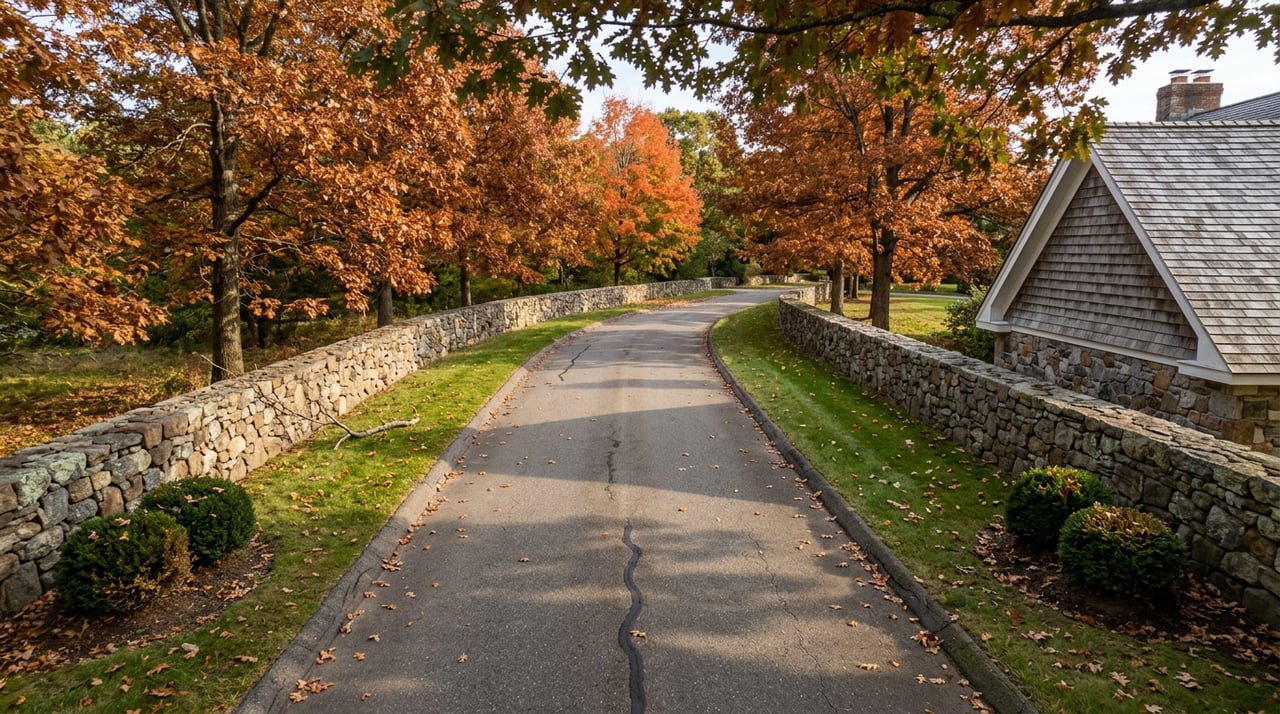
Walk the shoreline path around Crystal Lake on a cool September morning and you will pass a fishing platform, a stone wall with old gas lamps, and a squat brick bathhouse that has stood there since the lake's swimming days began. Nothing about the scene looks manufactured. It reads as old Newton, unhurried and permanent. But the name on the sign is the third name this water has worn, and the first two tell you something the third one hides: almost nothing you call permanent in this city arrived that way on purpose.
The lake's colonial name was Wiswall's Pond. For most of the 19th century, Newtonians called it Baptist Pond, after the church that used it for baptisms. Then commercial ice dealers, who harvested the lake for refrigeration and needed buyers to feel good about the product, renamed it Crystal Lake because it sounded better on an invoice. The name stuck not because it was true to the place, but because it was good marketing. That single fact changes how you read the rest of Newton's landmarks, because the same pattern shows up again and again once you start looking for it.
A Lake With Three Names and a State Classification
Crystal Lake is 33 acres, which under Massachusetts law makes it a "great pond," meaning the state, not the city, technically owns the water. The city manages the shoreline, which is why you can walk sidewalks and paths along three sides of it, covering a longest stretch of about 0.8 miles. The land itself came together in two very different eras, first in 1894 and again between 2007 and 2009, more than a century apart, which is part of why the coves around the lake feel like they belong to different centuries.
| Era | Name | Why It Changed |
|---|---|---|
| Colonial period | Wiswall's Pond | Named for early landowners |
| 19th century | Baptist Pond | Named for the church that used it for baptisms |
| Late 19th century onward | Crystal Lake | Renamed by ice dealers to make the product sound appealing |
The lake is currently closed for the season, per the city's own recreation listings, which means the swimming crowd has cleared out right as the walking crowd's best weather arrives. That timing is not an accident of scheduling so much as a feature of how this particular landmark works: it has always had two different audiences using it in two different ways, at two different times of year.
Two Coves, Two Centuries
The lake's coves make the point even sharper. Cronin's Cove got its wall and gas lights in an earlier era of civic improvement, the kind of Victorian-era infrastructure that reads as decorative today but was purely functional then. Levingston Cove, by contrast, got a new fishing platform in a far more recent round of upgrades, built for anglers rather than strollers. Stand between the two and you are standing between two different ideas of what public water is supposed to do for a neighborhood.
The bathhouse carries its own small piece of this history. According to Historic Newton's own spring 2019 newsletter, the structure's original purpose was blunt:
"to discourage swimmers from disrobing in public."
That is not a caption you would expect on a building most residents walk past without a second look. The city later used Community Preservation Act funds to acquire an additional lakefront parcel at 20 Rogers Street by eminent domain, specifically to expand the swimming area, which tells you the lake's boundaries have kept moving well into the modern era. Nothing about Crystal Lake was ever finished. It has been renamed, re-bordered, and re-purposed every few decades, and the version you see today is just the current draft.
The Suburb That Started as a Nursery
The renaming habit is not unique to the lake. Newton Corner, one of the city's most recognizable village centers today, was once the site of one of New England's first commercial nurseries, run by the Kenrick family, who cultivated fruit trees, ornamental trees, and shrubs on the acreage now covered by Newton Corner's streets and houses. An 1882 Kenrick family house still stands, and the Durant-Kenrick House and Grounds preserves part of the original footprint. A village most people assume was residential from the start was, for decades, a working commercial farm.
Auburndale carries a version of the same story, minus the happy ending. According to Historic Newton's own tour materials, the village was almost named Pigeonville. Somewhere along the way, a naming committee, a developer, or simple neighborhood preference won out over that option, and the record of why has mostly disappeared. What survives is the fact that it was on the table at all, which is enough to change how you think about every other village name in the city. Newton Highlands, Waban, Oak Hill, Chestnut Hill. None of them were guaranteed.
The Names You Already Say Every Day
This pattern gets most personal at Newton Cemetery, where Historic Newton runs a tour built around a single question: who inspired our school names? The tour visits the grave sites of Dr. Henry Bigelow, A.B. Underwood, and others whose names now sit on the fronts of Newton's elementary and middle schools. Parents who drop kids off at these buildings every morning are, in most cases, saying a stranger's name out loud without knowing anything about the person behind it. With several of Newton's public schools currently in some stage of renovation or reconstruction, the tour's organizers point out that this is an unusually good moment to learn where those names came from before the buildings themselves change shape again.
A companion tour walks East Parish Burying Ground, the resting place of some of Newton's earliest English settlers and the site of a 17th-century meetinghouse. The tour does not stop at the settlers. It also surfaces the histories of Indigenous Massachusett people and enslaved and free Black Newtonians who were never buried there, but whose presence in the city's early record is just as central to understanding how Newton actually formed. That absence, the people missing from the ground itself, is its own kind of historical marker.
The Architect Whose Own Stations Disappeared
The most literal version of Newton's disappearing-history problem runs on rails. H.H. Richardson, the dominant American architect of the 19th century and a Brookline resident, designed several stations along what is now the Green Line. Historic Newton runs a rolling tour on an actual Riverside train that passes the sites of three demolished Richardson stations, shows archival photos of what stood there, points out two later stations built by his successor firm in his style, and passes the single surviving original Richardson station in Newton. That building is neglected and no longer used as a station, and the tour's own description warns riders to look quickly, because it passes in a flash. A landmark building by one of the most important architects in American history sits unused in plain sight, and most people riding past it every day have no idea it is there.
How to Actually Take One of These Walks
Historic Newton runs this entire program on a modest, practical scale. Tours cost ten dollars for members and fifteen for non-members, run about ninety minutes, cover roughly a mile at an easy pace, and require registration in advance since space is limited and meeting locations are shared only after you sign up. The program is sponsored by Newton-Wellesley Hospital, and residents who want to be notified when the next season's schedule is announced can join the waitlist directly through Historic Newton's own walking tours page. Bring sturdy shoes and a water bottle. Most of these walks move at a pace built for conversation, not exercise.
None of this changes what your commute looks like or what you'll pay for a house near Crystal Lake next spring. It changes what you know about the ground your commute and your house sit on. The lake was never really called Crystal Lake. Newton Corner was never really just a suburb. The schools were never really just buildings. Once you notice that pattern once, you start noticing it everywhere in this city, which is the entire point of walking it on foot instead of driving past it.
If you are thinking about what a Newton address is actually worth, not just its history but its market position right now, that is a different conversation, and one Michael Quinn is glad to have when you are ready. Schedule a private consultation whenever the questions turn from the neighborhood's past to your own next move in it.