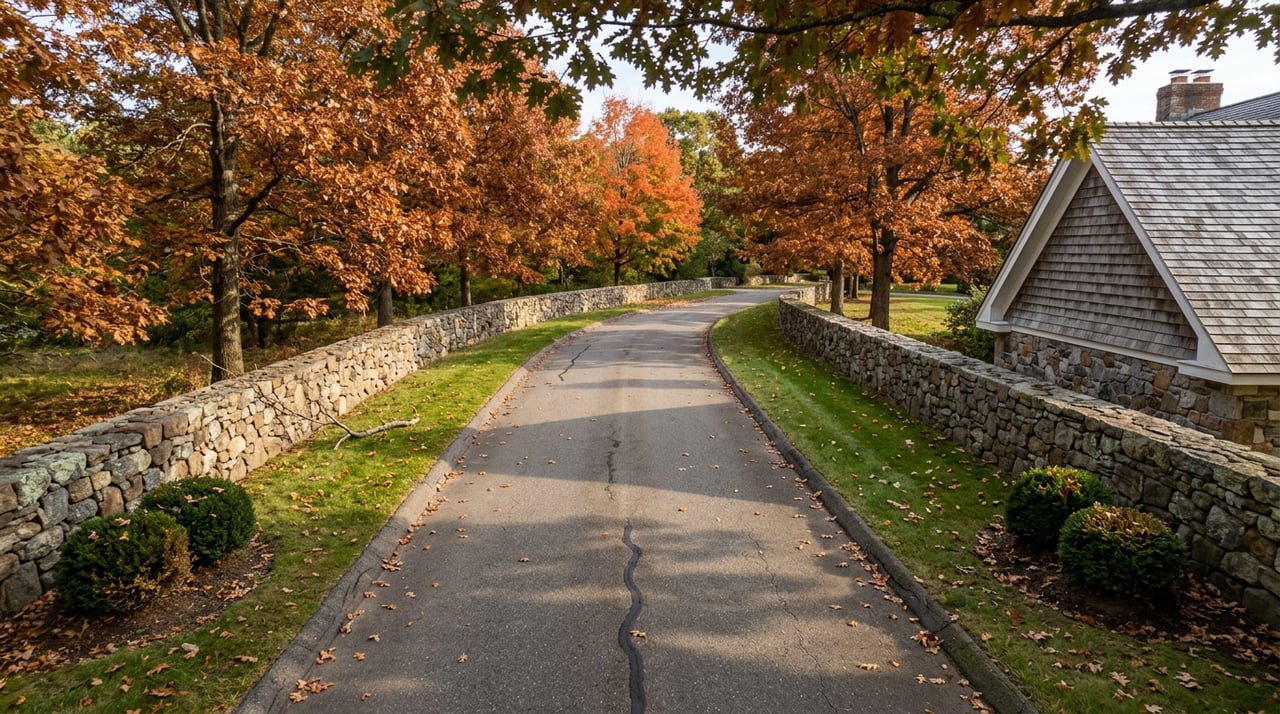
Drive down Doublet Hill Road on an August afternoon and you would never guess it carries any complication at all. Stone walls, old maples, a quiet climb toward a water tower at the top. It reads exactly like the rest of Weston: settled, private, expensive. What the pavement does not tell you is who actually owns it, who pays to plow it, and what happens to your mortgage application if that ownership question was never answered on paper.
That is the thesis worth sitting with before you tour a house on one of Weston's private lanes. The road itself, not the house, can decide whether your loan closes on schedule.
The Math The Listing Sheet Skips
Weston's own geography page puts total road mileage in town at 128 miles, with 83.7 of those miles classified as public. Do the subtraction and you land on roughly 44 miles, close to a third of every road in Weston, that the town has no legal obligation to plow, patch, or repave. That third does not show up on a property listing. It does not show up in a home value estimate. It shows up the first time a resident calls the Department of Public Works about a pothole and learns the town cannot legally spend a dollar fixing it.
Some of these streets are managed by a single organization, the Weston Roads Trust. Others, like Nonesuch Road, Nash Lane, Partridge Hill Road, and Pheasant Trail, are private but sit outside the Trust entirely, which means whatever maintenance arrangement exists there was worked out privately among neighbors, if it was worked out at all.
Who Actually Owns The Pavement
The Weston Roads Trust traces back to Robert Winsor, a financier and partner at Kidder, Peabody & Co., who began buying land in Weston in 1884. By 1919 he held more than 488 acres. He kept 16 for his own residence at 68 Winsor Way, donated 50 to form the Weston Golf Club, and placed the remaining 422 into a real estate trust that eventually became the Trust that maintains roads like Meadowbrook Road, Doublet Hill Road, Dellbrook Road, and Dogwood Road today. More than 150 parcels are tied directly to the Trust, with additional abutting parcels that benefit indirectly without paying full dues.
The Trust is careful about the limits of its own job. Its own FAQ describes the mandate as strictly the roadway and the asphalt: plowing, sanding, drainage, and repairs. It does not handle security, tree trimming beyond what blocks the road, or debris on private property. Doublet Hill Road has a separate wrinkle: a 1977 agreement lets the town maintain that stretch specifically to preserve access to a water tower at the top, even though the road itself sits inside Trust territory. Rolling Lane is only partially public, another reminder that "private road" in Weston is not one uniform category with one uniform answer.
Starting in 2026, the Trust began charging a fee equal to 0.25 percent of permitted construction cost on new residential projects within its boundaries, meant to offset the wear that heavy equipment and construction traffic put on roads the town will never pay to fix. If you are budgeting a renovation or new build on a Trust road, that percentage now belongs in your cost estimate alongside your builder's line items.
The Recorded Agreement Is The Real Collateral
Here is where the road stops being a charming detail and starts being a financing variable. Massachusetts has no statutory framework requiring neighbors on a private way to share maintenance costs. Maine does, through a law that spells out equal cost-sharing when no other agreement exists. Massachusetts has nothing comparable. Absent a recorded Private Road Maintenance Agreement, a homeowner on a Massachusetts private road has no legal claim to force a neighbor to pay their share, and no legal obligation to pay someone else's.
That gap becomes a lender's problem the moment it becomes a title problem. A mortgage advisory published earlier this year lays out the mechanism plainly: without a recorded agreement, a property that depends on a shared private road can become difficult to finance through conventional or jumbo channels, sometimes to the point where the only realistic buyer is one paying cash and willing to inherit the risk. That risk compounds in a market like Weston's, where financing is already jumbo by default. Weston's median home price sat at roughly $2.7 million as of August 2026, well above conforming loan limits, and homes here typically require jumbo underwriting with larger down payments and stricter documentation. A jumbo underwriter who spots an unrecorded private road on title is far more likely to ask hard questions than one reviewing a conforming loan on a public street in a neighboring town.
None of this means a private road disqualifies a purchase. It means the paperwork that proves the road's maintenance obligations is not optional homework. It is the difference between a smooth closing and a stalled one.
What This Actually Means Before You Make An Offer
If you are touring homes on a Weston lane that reads as private, a few questions belong on your list well before the inspection contingency deadline.
- Confirm whether the street appears on the town's official Public and Private Roads record, and if it is private, whether it falls under the Weston Roads Trust or a separate, informal arrangement among a handful of owners.
- Ask directly whether a recorded Private Road Maintenance Agreement exists, and if so, request a copy before you're deep into the transaction. Read what it says about cost-sharing and whether it grants lien rights for unpaid assessments.
- If the home sits inside Trust boundaries, ask about current dues and whether the 2026 construction fee applies to any planned work.
- Loop in your lender early. Jumbo underwriters vary in how they treat private road status, and finding out during underwriting week is worse than finding out during your first walkthrough.
- If you are selling a home on a private way, get the agreement documented and current before you list. A buyer's attorney will find the gap eventually. Better that it's already closed than that it becomes a renegotiation point during the option period.
For sellers weighing how much of this to put in front of buyers upfront, there is a real argument for handling it quietly rather than airing it publicly on the open market. A private preview through Sotheby's network lets you control who sees the property and when, which gives you room to have the maintenance agreement conversation with a serious buyer before the listing invites a wider audience to ask the same question cold.
A Few Questions Worth Asking Before You Tour
Does every private road in Weston belong to the Weston Roads Trust? No. Streets like Nonesuch Road, Nash Lane, Partridge Hill Road, and Pheasant Trail are private but sit outside the Trust, which means any maintenance arrangement there was set up independently, if it exists at all.
Will my mortgage lender actually care if the street is private? It depends on the lender and the loan type, but it can matter. Since Massachusetts has no law forcing neighbors to share road costs, some lenders want to see a recorded maintenance agreement before they will approve financing, and that scrutiny tends to be higher on jumbo loans, which describes nearly every purchase in Weston.
What changed with the Weston Roads Trust this year? Starting in 2026, the Trust began assessing a fee equal to 0.25 percent of permitted construction cost on new residential projects inside its boundaries, intended to help cover the road wear that construction traffic causes.
Weston's private roads are part of what makes the town feel the way it does. That character is real. So is the paperwork behind it, and the paperwork is what determines whether your closing date holds. If you're weighing a purchase or a sale on one of these streets and want a clear read on what the title and the lender will actually ask for, Michael Quinn can walk through it with you. Schedule a private consultation before you fall for the lane and find out about the liability later.